Beyond the Boundaries of the Universe
Stringism proposes that everything in existence is connected through strings. These strings form nodes, and nodes form the structures that create the reality you experience. From the smallest particles to living beings, planets, stars, and galaxies, everything can be understood as part of an immense interconnected network.
Modern science has revealed that the observable universe is vast beyond imagination. Yet even this observable universe has boundaries. The speed of light limits what can be seen, meaning that there are regions of existence forever beyond our observation. What humanity commonly refers to as "the universe" may therefore represent only a portion of a much larger reality.
Within Stringism, strings are considered more fundamental than the structures they create. Galaxies emerge from strings, stars emerge from strings, and life itself emerges from strings. It is therefore conceivable that strings extend beyond the structures currently known to us.
If a galaxy can be viewed as a knot of strings, and a universe can be viewed as a larger knot of strings, then the possibility arises that multiple universes may exist within an even greater network. Such universes would not necessarily be isolated creations but rather separate manifestations of the same underlying fabric.
Stringism does not claim the existence of a multiverse as fact. Rather, it recognizes that if strings are truly fundamental and unbounded, the existence of multiple universes becomes a natural possibility worthy of consideration.
A Network of Universes
In this perspective, reality may resemble an endless web of interconnected knots. Some knots form stars. Others form living beings. Still larger knots may form entire universes.
Each universe could possess its own characteristics, its own physical laws, and its own history. Some may be dramatically different from our own, while others may share many similarities. Just as no two living beings possess identical arrangements of strings, no two universes would necessarily develop in exactly the same way.
The concept of multiple universes often appears in science fiction and theoretical physics. Stringism approaches the idea from a different direction. Rather than focusing on mathematical models or parallel timelines, it considers the possibility that all universes are expressions of the same fundamental network of strings.
In such a framework, universes are not separate creations competing for existence. They are neighboring knots within a larger structure whose full extent may be beyond comprehension.
Consciousness Beyond Our World
The possibility of multiple universes naturally expands the discussion of life and consciousness.
Humanity has long wondered whether it is alone. Traditionally, this question has focused on the search for life elsewhere in our universe. Stringism allows for that possibility while also suggesting a broader perspective.
If consciousness emerges from sufficiently complex arrangements of strings, then consciousness may not be unique to humanity, Earth, or even our universe. Wherever strings organize themselves into structures capable of awareness, experience, and memory, forms of consciousness may emerge.
Such consciousness may differ greatly from our own. The beings that result could perceive reality in ways that are impossible for humans to imagine. Their experiences, senses, and understanding of existence may be shaped by entirely different arrangements of strings.
This perspective does not provide answers regarding the existence of extraterrestrial or extra-universal life. Instead, it offers a framework in which consciousness is viewed as a natural consequence of complexity rather than a unique accident limited to a single world.
The Reality Within
While the possibility of other universes encourages exploration outward, human experience also reveals the existence of realities created inward.
Every person experiences dreams. During these moments, consciousness constructs environments, people, emotions, and events that often feel completely real while they are being experienced. Although these realities disappear upon waking, they demonstrate the remarkable ability of the mind to generate coherent worlds.
Beyond dreams, there are accounts of extraordinary experiences in which individuals describe living what appears to be an entirely separate existence. One example frequently discussed is the case of Clélia Verdier, who reported experiencing what felt like another life during a coma. According to her account, this alternative existence contained relationships, memories, routines, and the passage of time, all experienced with the same sense of reality as everyday life.
Stringism does not regard such accounts as proof of alternate universes or hidden dimensions. Experiences of this nature may be fully explained by neurological processes within the brain. Their significance lies elsewhere.
They demonstrate that consciousness possesses an extraordinary capacity to create experiences that feel authentic and complete. Whether these experiences originate entirely within the mind or reflect mechanisms not yet understood remains uncertain. What is clear is that reality, as experienced by an individual, is deeply connected to consciousness itself.
The existence of such experiences invites reflection on the relationship between perception and reality. The world humans experience is not merely received; it is interpreted, organized, and assembled through the structures that make up the conscious mind.
The Matrix Without the Machines
Popular culture has often explored similar themes. One of the most recognizable examples is The Matrix, a story in which reality is experienced through an artificial construct rather than through direct interaction with the physical world.
Stringism does not require simulations, machines, or hidden controllers. Nevertheless, the philosophical appeal of such stories lies in their examination of perception. They illustrate that the experience of reality depends not only on what exists externally but also on the mechanisms through which reality is interpreted.
Every individual already experiences a unique version of the world. Two people can witness the same event and form entirely different memories, emotions, and conclusions. Their strings connect information differently, creating distinct experiences from the same external circumstances.
In this sense, reality is both shared and personal. The physical world may provide a common foundation, but the experienced world is assembled uniquely within each conscious node.
Shaping the Universe We Experience
One of the practical implications of Stringism emerges from this understanding of consciousness.
If the experience of reality is influenced by the arrangement of strings within an individual, then personal growth becomes a process of reshaping those strings. Every experience, every relationship, every lesson learned, and every challenge overcome contributes to the ongoing evolution of the individual node.
Reading a book adds new strings. Learning a skill strengthens existing ones. Forming meaningful relationships creates new connections. Letting go of outdated beliefs may untangle strings that no longer serve a purpose.
Over time, these changes alter the way reality is experienced.
The external universe may remain unchanged, yet the universe experienced by the individual transforms continuously. In this sense, personal development can be understood as a process of consciously influencing the structure through which reality is perceived.
This idea should not be interpreted as an attempt to escape reality. Rather, it recognizes that the observer is an active participant in the construction of experience. By shaping the strings that form oneself, one gradually shapes the reality one inhabits.
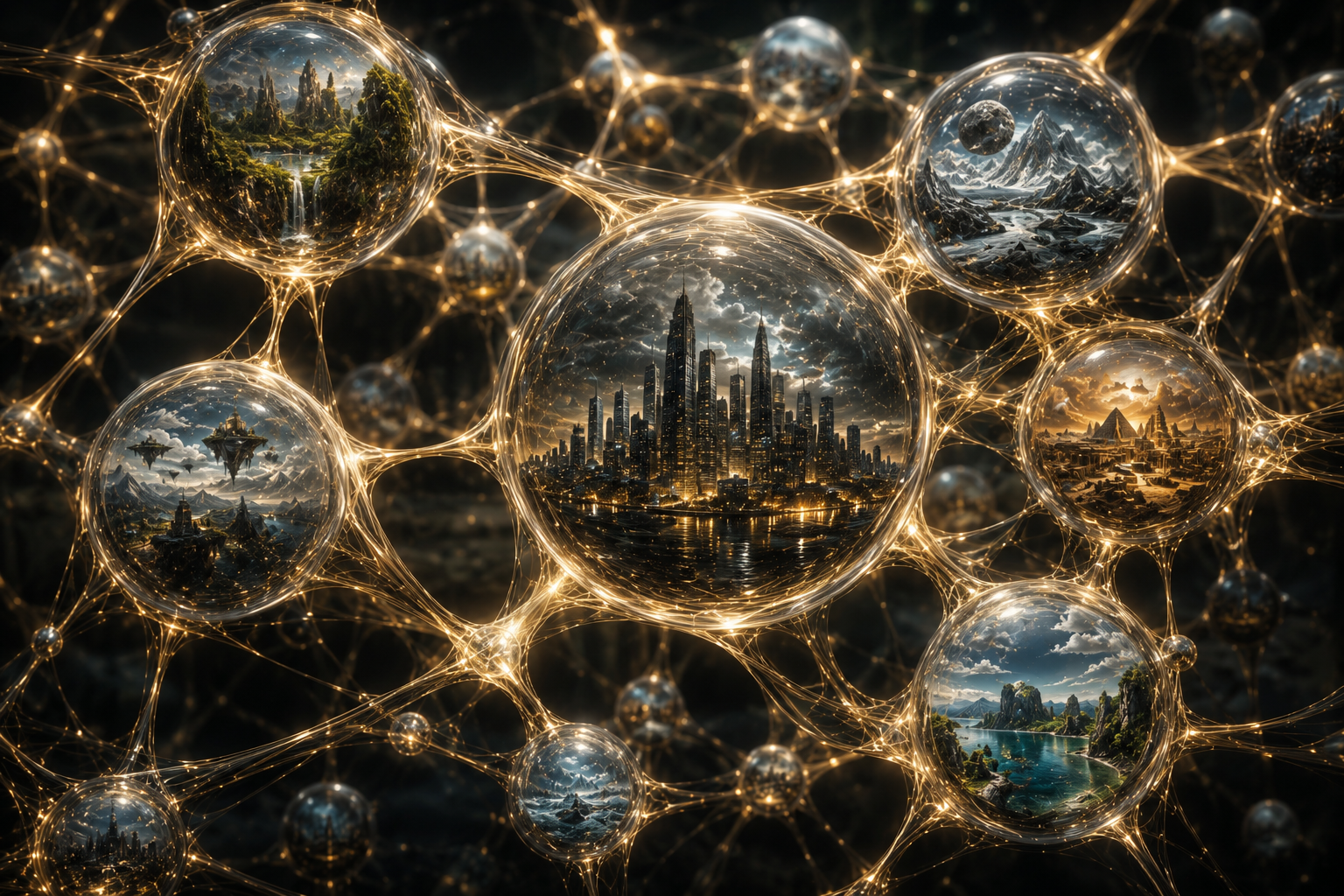
Stringism views existence as a network of interconnected strings extending beyond the limits of current understanding. Within such a framework, the possibility of multiple universes becomes a natural extension of the belief that strings are more fundamental than the structures they create.
Whether other universes exist remains unknown. Whether consciousness extends beyond our world remains unknown. Whether the realities experienced within dreams, imagination, and extraordinary states of consciousness reveal deeper truths remains unknown.
Yet uncertainty does not diminish the value of exploration.
The history of human understanding has repeatedly demonstrated that reality is larger, more complex, and more interconnected than previously believed. Stringism embraces this possibility and suggests that the boundaries currently perceived by humanity may represent only a small portion of a far greater network.
If strings truly form the foundation of existence, then the universe may be only one knot among countless others, all woven together within a fabric whose full extent has yet to be discovered.