Can one person ever be enough?
One of the most fascinating aspects of human existence is the complexity that exists within every individual. At first glance, people often appear simple. We describe ourselves through a profession, a personality, a role within a family, or perhaps a collection of interests and beliefs. Yet beneath this surface lies a far more intricate reality. According to Stringism, every person is a node formed by countless interconnected strings defining who we are and what we have lived and believed. A knot brings those experiences together. Those knots and strings together create the unique pattern that defines an individual soul.
Because every node consists of such an immense network of strings, no two people are ever truly identical. Even when individuals share similar backgrounds, cultures, or experiences, the exact arrangement of their strings remains unique. Throughout life, new strings emerge while existing ones strengthen, weaken, and intertwine. The result is a continuously evolving structure that can never be fully understood, even by the individual who carries it.
This observation naturally leads to an interesting question regarding relationships. If every human being consists of such a vast and ever-changing network of strings, can another single person realistically connect with all of them?
For many people, monogamy offers a convincing answer. Throughout history, countless individuals have found happiness, stability, and meaning through a lifelong partnership with one person. There is something deeply powerful about two nodes gradually intertwining their strings over decades of shared experiences. Every challenge overcome together strengthens the connection. Every memory adds another thread to the growing knot that binds two lives together. Over time, the relationship itself becomes a structure that supports both individuals, providing familiarity, trust, and a sense of belonging that few other human experiences can match.
From a Stringism perspective, monogamy can therefore be viewed as a process of deepening connection. Rather than creating many pathways, energy is continuously invested into a single bond. This concentrated investment allows the relationship to develop extraordinary depth. The two nodes become increasingly familiar with one another's patterns. As years pass, the connection often grows stronger because the strings themselves become more intertwined.
Yet depth does not automatically imply completeness.
Even within the strongest relationships, there are often strings that remain only partially connected. Or strings might even disconnect over time while other knots form and previous connecting knots loosen. A person may share nearly everything with a partner and still discover aspects of themselves that receive little resonance in return. One individual may possess a strong desire for philosophical exploration, while the other finds greater fulfillment in practical matters. One may seek adventure and novelty, while the other finds comfort in stability and routine. One may gain energy through social interaction and affection, while the other restores energy through solitude.
Such differences do not indicate a failed relationship. In fact, they often exist within highly successful partnerships. The question is simply whether it is reasonable to expect one person to satisfy every significant string within another human being.
Stringism does not attempt to answer this question with certainty. Instead, it encourages observation.
When we examine human life more broadly, we quickly notice that different people already fulfill different roles within our network of connections. Friends often provide forms of understanding that family members cannot. Parents contribute something unique that partners cannot replace. Mentors, colleagues, children, and even occasional acquaintances may activate strings that would otherwise remain untouched. Human beings naturally create diverse networks because different connections generate different forms of energy.
Seen from this perspective, it becomes possible to consider whether romantic relationships might sometimes follow a similar pattern. If a person discovers that one connection resonates deeply with certain strings while another connection naturally aligns with others, must this automatically be viewed as a problem? Or could it simply represent another way in which complex networks of strings organize themselves?
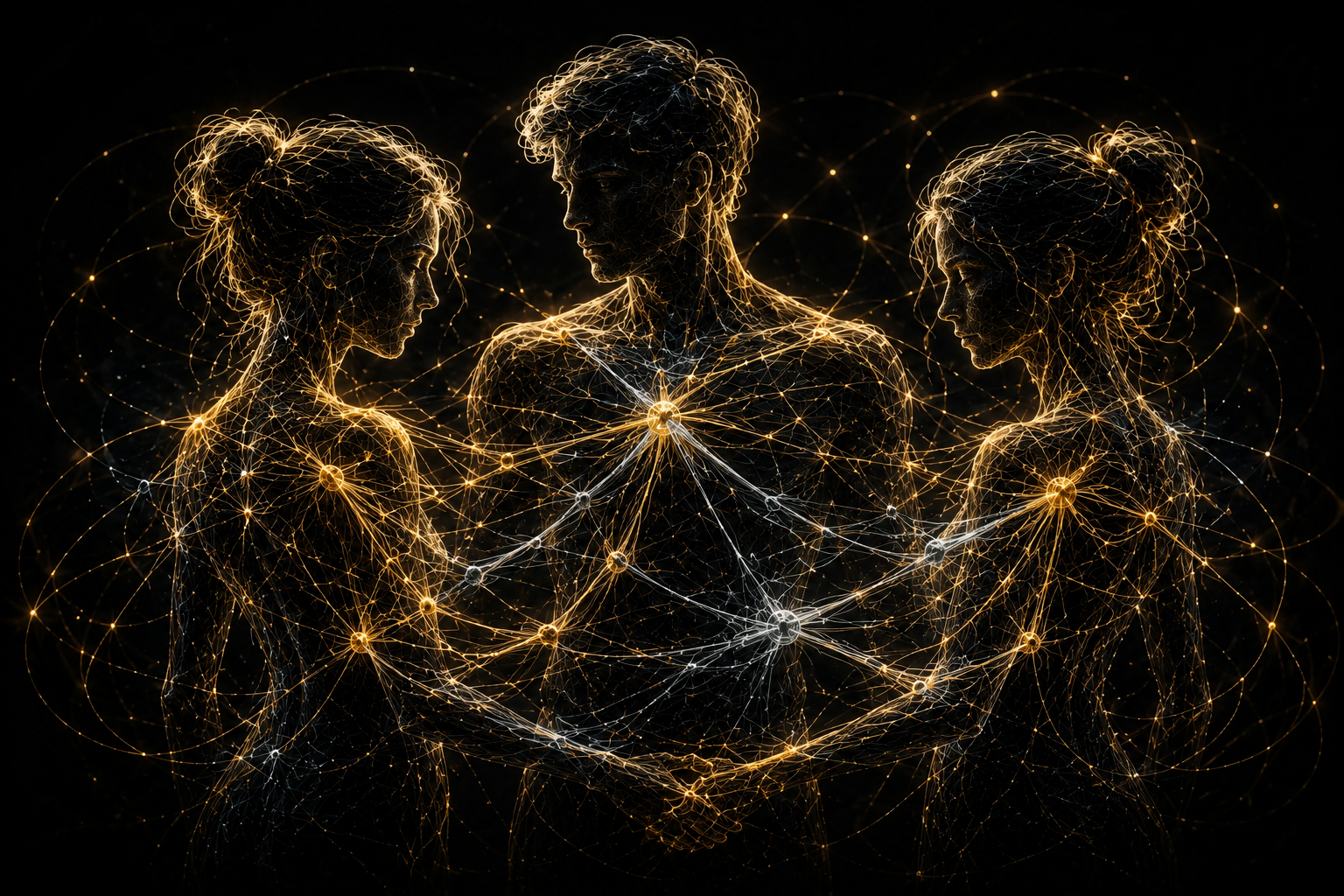
This possibility forms part of the philosophical foundation behind multiple romantic connections. The idea is not necessarily that one relationship is insufficient, nor that an existing bond lacks value. Rather, it is the recognition that different individuals may contribute different forms of energy to the same node. One person may stimulate creativity and intellectual growth, while another offers emotional stability and comfort. Neither connection replaces the other because each resonates with different parts of the network.
Of course, such structures introduce complexities that monogamous relationships often avoid. Every additional connection introduces new strings into the system. New strings create new opportunities for growth, understanding, and support, but they also introduce additional points of tension. Emotions such as jealousy, insecurity, fear, and uncertainty are themselves strings that become part of the network. Managing multiple meaningful connections therefore requires navigating a considerably more complex structure than the one found within a traditional partnership.
For this reason, Stringism does not propose that monogamy should be replaced, nor does it suggest that multiple romantic connections are inherently superior. Both approaches can be understood as different architectures through which human beings organize their strings. Some individuals appear to flourish when the majority of their emotional energy is concentrated within a single deep connection. Others seem naturally inclined toward broader networks in which several meaningful connections coexist and support different aspects of their lives.
The success of either structure depends less on the number of people involved and more on the quality of the connections themselves. A relationship that consistently generates understanding, growth, support, and positive energy strengthens the network regardless of its form. Conversely, a relationship that continually drains energy, creates imbalance, or restricts personal growth may weaken the network regardless of whether it involves one person or many.
Perhaps the question is therefore not whether one person should be enough. Such a question assumes that human relationships can be measured through a universal standard. Stringism suggests that reality may be more nuanced. Every node is unique, every network develops differently, and every individual carries a distinct arrangement of strings and one can choose to focus on the connecting ones, or to connect in an ever bigger network, maybe less strengthening the knots between 2 beings but focusing more on having an extended and higher level of interconnections.
As with many observations within Stringism, the conclusion remains intentionally open. Human beings are among the most complex nodes we have encountered, and the patterns they create are equally diverse. Some will find profound fulfillment in a single lifelong connection. Others may discover that multiple meaningful connections better reflect the complexity of their own network of strings, thus opening up the possibilities of monogamy, for life, or shorter.