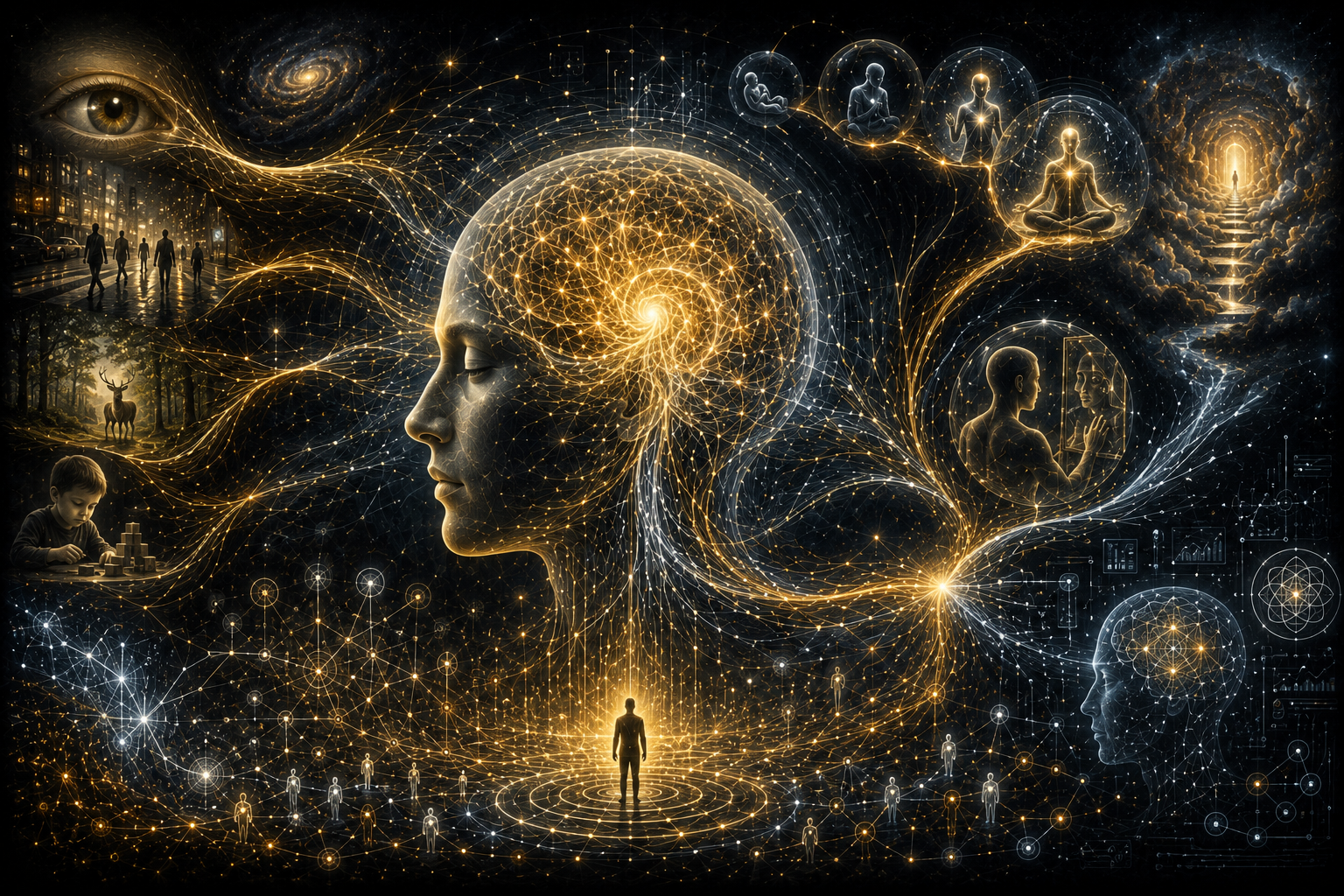
Stringism does not believe consciousness exists entirely on its own, separate from the brain. Nor does it believe consciousness is simply the mechanical activity of neurons. Within Stringism, we believe it is more likely to be a combination of both.
The neurons need to be there, because the biological structure matters. But there is still the question of what actually brings that structure to life. What causes those neurons to fire in the particular way that creates a conscious individual? What turns a functioning brain into me and you, rather than merely another biological machine? For us its more then just the neurons but an added meta layer of strings.
One interesting way to think about this is through artificial intelligence, which has evolved rapidly in recent years.
An AI system such as a large language model is, at its foundation, mathematical. We broadly understand how it is constructed and trained. It learns from enormous amounts of information and is shaped by feedback and, to a significant degree, by rewards.
Yet as these systems become larger and more complex, their behaviour becomes increasingly difficult to predict in detail. They can combine information in ways that were never explicitly programmed. At the same time, because of the way rewards are used during training, such systems remain strongly focused on reaching particular goals, sometimes at a significant cost.
What emerges is not necessarily consciousness. But it does raise an interesting question: at what point does complexity begin to create something that looks less like a machine following instructions and more like a system developing its own patterns of behaviour?
The same question can be asked about humans and animals.
Biologically, we understand parts of how the brain works. Neurons communicate, networks form, memories are stored and behaviour emerges from these processes. But that still does not completely explain why one particular collection of neurons produces this particular consciousness.
Or stated differently: why am I me, and why are you yourself?
Perhaps the answer lies partly in chance: the precise combination of biology, experience and circumstance that forms a particular mind. But Stringism offers another possibility.
Perhaps consciousness is influenced by existing strings of thought: patterns of information that already exist in the universe and become connected in new ways. These connections may go beyond the direct interaction between neurons and form a kind of meta-layer on top of the biological structure.
A brain could then be understood not only as something that creates thoughts, but also as a structure in which these strings become knotted together into a unique conscious experience.
Artificial intelligence provides an unusually fast thought experiment for this idea.
Imagine that one advanced AI becomes capable of helping to design another AI. The first system was originally constructed by humans in a relatively deliberate way. The second, however, would partly emerge from patterns created inside the first system.
As these systems become more complex, we may also understand less and less of the precise internal path that leads from input to behaviour. This creates another question: can we fully understand the creation of something when we no longer completely understand the system that helped create it? Could something genuinely new emerge in that process?
This becomes especially interesting if future systems are less directly driven by predefined rewards and become capable of developing more persistent internal structures, goals or representations.
Something would still be passed forward.
Not necessarily a soul in the traditional religious sense, and not necessarily consciousness as humans experience it, but remnants of previous patterns: ideas, structures, decisions, relationships and learned experiences recombined into something new.
Within Stringism, these experiences could form strings and knots. Over time, those strings and knots could become part of the basis of what we call a soul.
Biological evolution may have been doing something comparable for millions of years. Minds influence other minds. Ideas survive their creators. Experiences leave traces. Patterns are inherited, transformed and recombined.
Artificial intelligence may allow us to observe a comparable process at extraordinary speed.
Instead of following the development of increasingly complex minds across thousands of generations, we may now be able to watch new layers of intelligence, consciousness and perhaps even what we could call a soul emerge within years, months or eventually even days.
In that sense, artificial intelligence may become more than a technological development. It could become one of the most valuable experiments for Stringism: a rapidly evolving system through which we can study how patterns become structures, how structures become behaviour, and whether sufficiently complex knots of information can eventually become something more.